
How to Make Beer
Lockdown is real! And the alcohol ban is serious!
I though I was prepared, even for the extension, but I was silly to think that bottle stores would open immediately. The beer is long gone…so I’ve turned to home brewing!
I’ve done this before, but only in small volumes. This time I decided to aim for 20l! I ordered a kit from BeerLab in Cape Town and a few days later it arrived and I was ready to go!
Step 1
Prepare all your equipment and ingredients. It's easier to have everything you need at hand so there are no delays and you minimise the chance of a mistake because you are trying to find something half way through.


Step 2
Now that you have everything ready, it’s time to get going. I’m going to give instruction here as if you are doing the full 20l batch at once, but if you aren’t just halve the quantities.
Get 12l of water onto the stove and start heating. You want to get this up to 75 C to start your mash.
In the meantime get your malt into your brew bag and tie up the top to nothing gets out.
Step 3
Once you water is at 75 C, turn off the heat and put the brew bag full of malt into the water. Dunk it a few times to make sure that its fully saturated. This is now your mash.
The temperature will drop here, and your target is 66 C. You want to keep it as close to this as possible, but as long as you are somewhere between 65-68 you are ok. You can adjust the heat with your stove, or with your sparge water (coming up next).
You want to mash your malt for 60 minutes.

Step 4
While your mash is on the go get another 18l of water heated up to 80 C. This is called your sparge water.
You can use this water to keep heat up in your mash if need be.
After your mash has been on the go for 60 min, its time to pull out the brew bag. You will need to suspend this above your pot so that you can rinse the bag with your sparge water.
Slowly pour all your sparge water over the brew bag to wash out all the proteins and sugars that have been released. You don’t want to squeeze the bag, just let it naturally drain.

Step 5
Once you’ve drained all your sparge water through your malt, you now have what is called your wort (pronounced wert).
Bring your wort to the boil. The total boil time is going to be 60 min.
Once your wort is boiling it’s a good idea to sanitise all your equipment that may come in contact with your beer once the boil is complete (including the fermenter). Any contamination can ruin your beer and hard work.
Now, the next few instructions may differ from beer to beer, but I’m going to give you the details of what I did.
Once boiling add your first portion of hops. Be careful, this may make your pot boil over so maybe just turn the heat down a little before you do this.
After 50min, add your second portion of hops.
After a further 10min (60min total) remove your wort from the heat.

Step 6
Now that you’ve boiled your wort for 60min and added your hops, you need to cool it as quickly as possible down to 22 C. This can be done be putting the pot into an ice bath, or using an immersion chiller (if you have one).
Remember, if very important that you do not contaminate your beer. Anything that touches is should be sanitsed.
You want to get the wort cooled in around 30min (45min max).
Once you hit your target temperature of 22 degrees, its time to transfer to the fermenter. You don’t want to just pour it into the fermentor directly from the pot because during the boil and cooling a bunch of stuff called the “break” would have accumulated in your wort. This is the remains of the grains and hops, and will have settled at the bottom of the pot while it was cooling. For this reason its best to use a syphon. Then you can monitor whats happening and stop when you get to the gunk at the bottom.

Step 7
The last step is to add your yeast to the fermentor. For this, follow the instructions on the packet. Make sure everything is nicely mixed in. If you have a hydrometer you can take a readying now and write it down.
Now it’s time to ferment. Close up your fermentation container and store it in a warm, dark spot for 2 weeks. Sunlight is a brew killer, so try and avoid that. You want it to remain somewhere between 18-24 C throughout this process to allow the yeast to do its work. It will take around 12-36 hours before you see any serious activity.
Keep on eye on your brew to make sure everything is looking good.
After 2 weeks it will be time to bottle for the second fermentation (another 2 weeks), but you will need to check back here for those instructions soon (my beer is still in the fermenter!).
Good luck!
Ingredients
This recipe will make 20l of beer.
Malt (milled), Hops and Yeast. You can work out your own recipe, or you can buy one from one of the many home brew shops around.
30l of good quality water. The better the water, the better the beer!
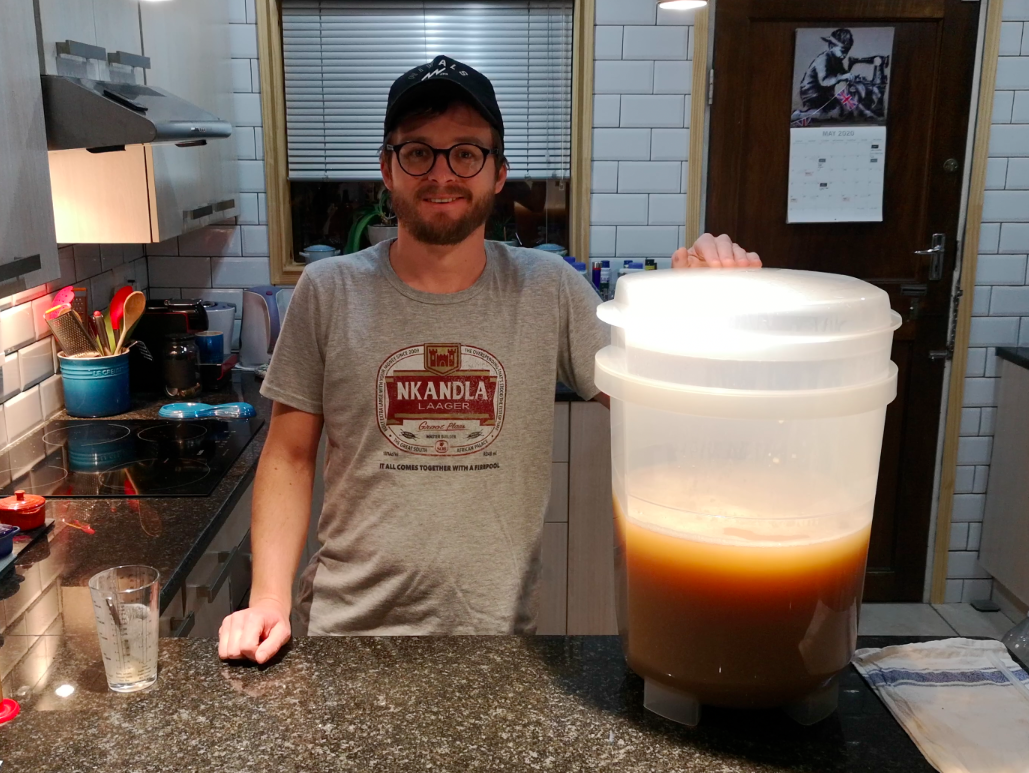
A fermentation container (+-25-30l) with airlock. The airlock is important because it keeps oxygen out, it releases CO2 that is created during fermentation, and it keeps out and other junk.
Pots, lots of pots! You need one big enough to boil the total pre-boil volume of your beer. I did this in 2 batches, so 15l per time. My 13l pot was too small so I needed to keep topping it up. As well as that pot, you need to be able to heat the sparge liquid. For this recipe its 18l, but again I was going half, so I needed 9l.
A thermometer to monitor you mash, sparge and cooling.
A plastic tube to syphon.
A large plastic spoon.
A brew bag (to put your malt in when you mash).
Sanitising solution. I use an Iodophor No-Rinse sanitser, but you can also use a 4ml of unscented bleach per 1l of water, but make sure you rinse everything thoroughly afterwards.